
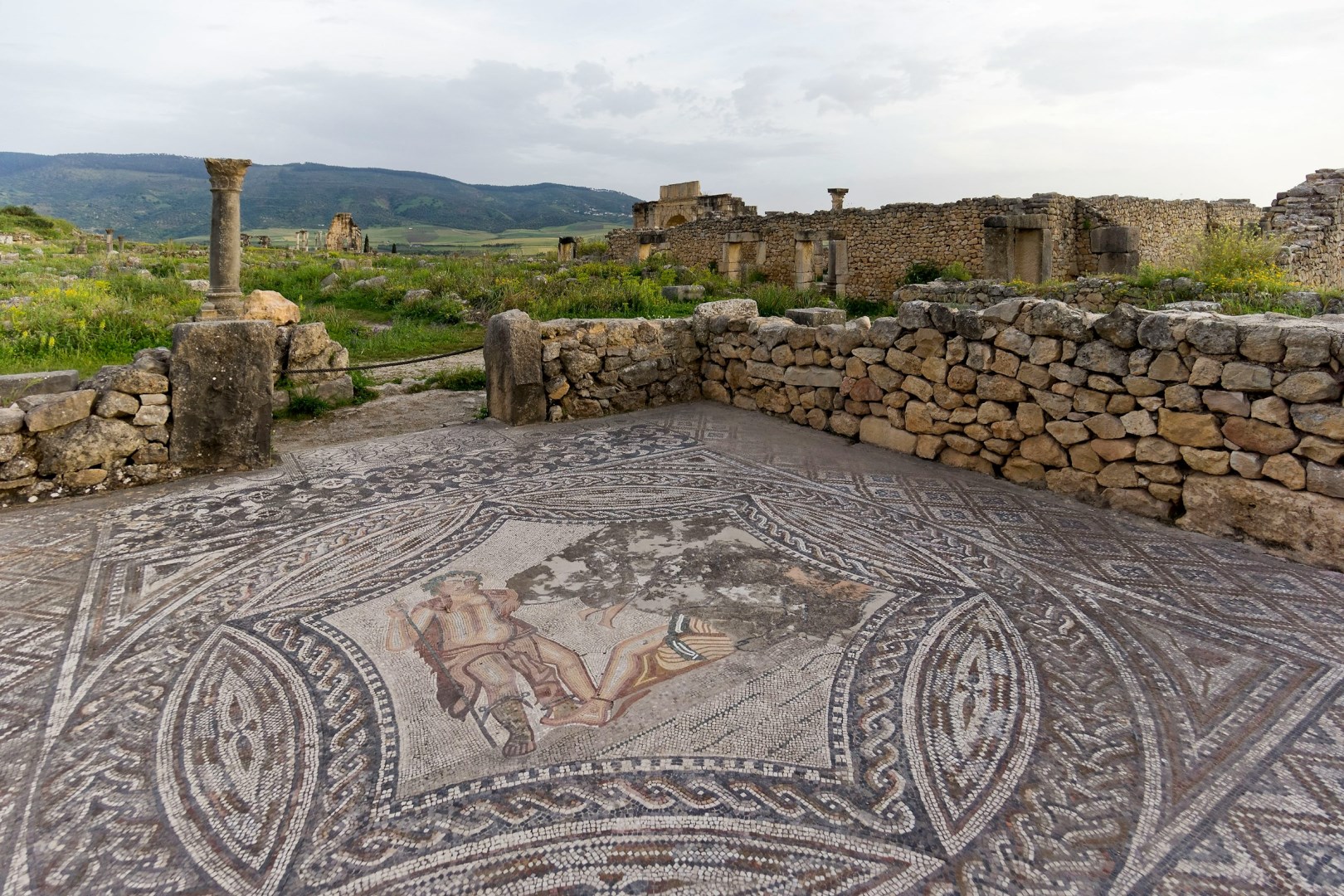
Volubilis is an extensive archaeological site in northern Morocco, located near the pilgrimage town of Moulay Idriss Zerhoun and surrounded by fertile farmland at the foot of Jbel Zerhoun. The ruins represent one of the country’s most important ancient urban sites, with temples, public buildings, residences, defensive walls, and elaborate mosaic floors spread across a broad hillside. Its location overlooking the surrounding agricultural plain helps explain the settlement’s importance. Volubilis is also recognized as a UNESCO World Heritage Site for its exceptional evidence of cultural exchange between North African and Mediterranean civilizations.
Volubilis reflects several layers of Moroccan history, including its origins as a Mauritanian settlement and its later development under Roman rule. The site also preserves evidence of indigenous North African traditions alongside Roman architectural and artistic practices. After the Roman period, the settlement continued to have an important role and was later associated with Idris I, founder of the Idrisid dynasty, whose tomb is at nearby Moulay Idriss Zerhoun. Inscriptions found at the site provide valuable information about the people, institutions, beliefs, and languages connected with the ancient city.
The archaeological area contains several remarkable structures, including the Basilica, Capitol, Arch of Caracalla, Roman baths, and the long Decumanus Maximus. Several private houses retain detailed mosaic floors depicting mythological figures, animals, and scenes from daily life. The House of Orpheus is notable for its mosaics and surviving olive presses, while the House of the Ephebe and House of the Venus offer further examples of decorated Roman residences. The surrounding landscape remains largely agricultural, with rolling fields and the slopes of Jbel Zerhoun providing a natural setting for the ruins.
Volubilis is especially notable for its collection of preserved mosaics, which provide a glimpse into the artistic preferences and domestic life of wealthy residents. Olive production was also important, and numerous presses found among the ruins point to the role of agriculture in the local economy. The site contains hundreds of inscriptions as well as marble and bronze sculptures, making it valuable to archaeologists as well as visitors interested in architecture. Its proximity to Moulay Idriss Zerhoun also allows the ancient ruins to be experienced alongside a living Moroccan town whose religious traditions remain an important part of the region.
Other Popular Destinations in Morocco