

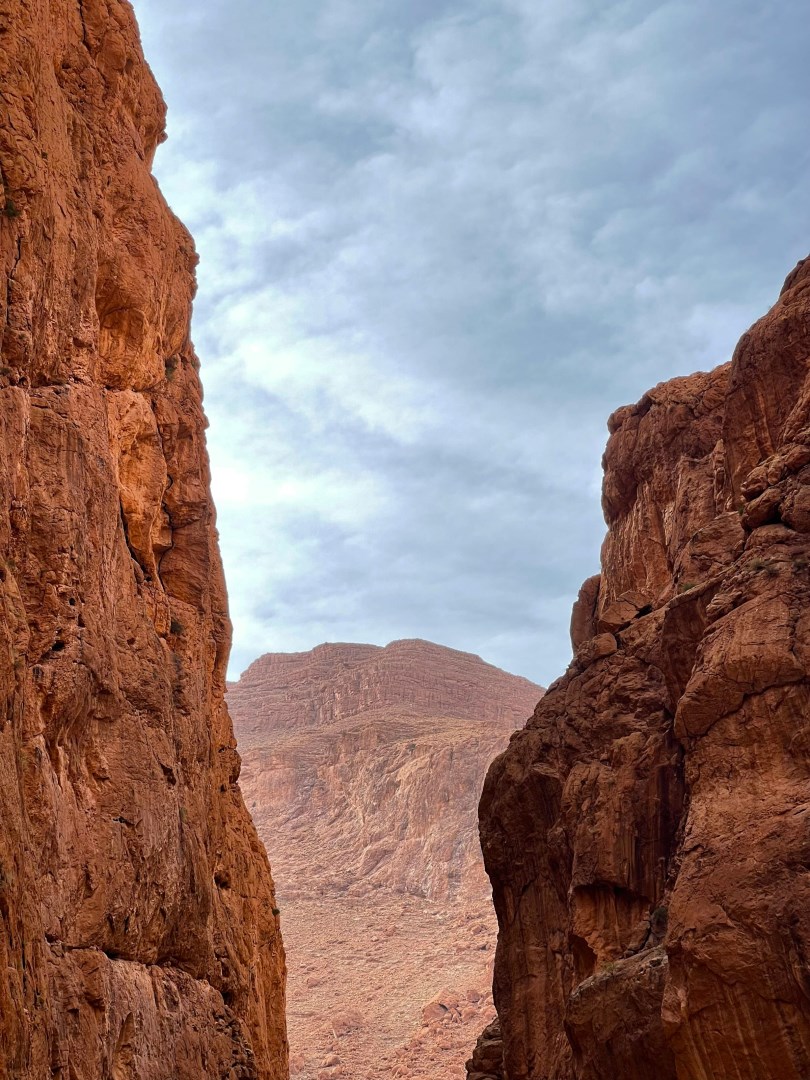
Todgha Gorge is a dramatic limestone canyon in Morocco’s eastern High Atlas Mountains, close to the oasis town of Tinghir. The Todgha River has cut a deep passage through the mountains, leaving towering rock walls that rise to around 300 meters in places. At its narrowest, the gorge contracts to roughly 10 meters across, creating a striking corridor of stone and sky. A paved road follows the canyon floor through the main section, making the gorge accessible without a demanding hike. Palm groves and traditional villages surround the lower valley.
The gorge forms part of the wider Todgha Valley, an area shaped by Amazigh communities and oasis agriculture. Water from the Todgha River supports palm groves and cultivated land farther downstream, where families grow dates, olives, fruit, and vegetables. Traditional villages and earthen buildings are scattered through the valley, connecting the dramatic mountain landscape with settled agricultural life. The gorge itself has also developed a strong climbing culture, with local guides and international climbers using the limestone walls. Its location along routes linking the High Atlas with the desert has made the valley an important passage through southern Morocco.
The narrowest section of Todgha Gorge is the main attraction, where near-vertical limestone walls tower above the road and riverbed. Visitors can walk along the canyon floor, continue farther into the valley, or explore trails leading toward the surrounding mountains. The cliffs are also a major rock-climbing destination, with routes established across the limestone faces. Beyond the gorge, the Todgha palm grove provides a contrasting landscape of green vegetation and shaded paths. The nearby town of Tinghir offers access to the gorge, while the wider valley contains kasbahs, villages, and mountain viewpoints.
The agricultural landscape around Todgha influences local food, particularly through the production of dates, olives, almonds, and seasonal fruit. Moroccan staples such as couscous and tagine are widely served in guesthouses and restaurants in Tinghir and the surrounding valley. Mint tea remains a familiar part of local hospitality. One distinctive feature of Todgha Gorge is the way the river connects several very different environments: narrow limestone cliffs in the upper gorge, cultivated palm groves farther downstream, and dry mountain terrain beyond the oasis. This close contrast makes the gorge especially useful for understanding the geography of southeastern Morocco.
Other Popular Destinations in Morocco